Mapping out the longitudinal bi-directional connections between depression and social life
Dr. Anderson and Mallory Lastrapes published a paper based on data from the Wisconsin Longitudinal Study, examining how social life and depression are associated in older adults
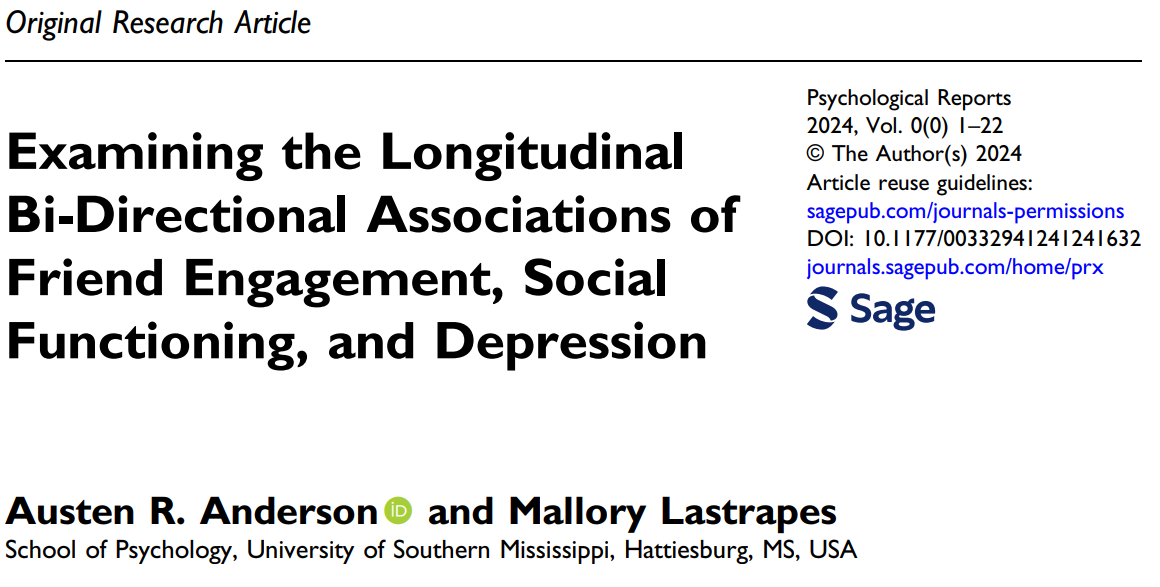
Mallory Lastrapes, a current 4th year PhD student at the University of Southern Mississippi and LEAF Lab P.I. Austen Anderson recently had a paper published in Psychological Reports. In line with the Surgeon General’s recent report on loneliness and the uptick in organizations seeking to address the importance of social life (e.g. Foundation for Social Connection), we sought to explore how social interaction, social functioning and depression were associated using three waves of data from the Wisconsin Longitudinal Study. The data spanned almost 30 years and was focused on individuals who graduated from Wisconsin high schools in 1956. The average age of participants in the last wave (2011) was about 71 years old.
What set this project apart were the use of analyses that distinguished between stable trait-level associations versus fluctuations over time.
The key findings were:
- As expected, at a trait level, individuals who reported more frequent friend engagement and higher social functioning on average across the decades had significantly lower average levels of depressive symptoms.
- At any given time point, higher than average friend engagement frequency and social functioning were associated with lower than average depressive symptoms in that same period. And because we used Random-Intercept Cross-Lagged Panel modeling, these associations were controlling for trait-level associations.
- Higher than average social functioning predicted lower depressive symptoms up to 10 years later, even after controlling for previous depression levels.
- There were some gender differences - decreases in friend engagement predicted later increases in depressive symptoms for men but not women.
- We conclude, along with many others (e.g. Cruwys et al., 2014), that social connection should be a major target for preventing and treating depression. “Improving social connections emerges as a pivotal treatment target, bolstered by robust evidence derived from this and other longitudinal studies” (Anderson & Lastrapes, 2024).
While previous research has linked social factors to depression, this study used advanced modeling to better establish the directional effects over long time periods while separating stable trait levels from temporary fluctuations. The findings underscore how crucial it is to maintain an active social life and sense of social functioning as we age for protecting mental health. In an era of increasing loneliness and social disconnection, investing in building strong social bonds and communities may pay major dividends for preventing depression across the lifespan. The study reinforces that we are truly social beings who struggle to flourish without positive social connectedness.